Immobiliare.it - Indomio
- 4.8
- Rating
- 10.00M
- Installs
- Free
- Price

 Analysis by App-foxy
Looking for a home is rarely a single search. It usually starts with a vague need, turns into saved listings and messages, then becomes a tiring process of comparing locations, budgets, transport, and paperwork. I found Immobiliare.it - Indomio most useful when I treated it as the first working desk for that process rather than as a magic shortcut to a finished rental or purchase. It brings together property searches for Italy and Spain, which makes it especially relevant if you are moving between those markets, comparing cities, or simply trying to understand what your budget can buy.
The app belongs to the House & Home category and is developed by Immobiliare.it S.p.A. It is free to use, aimed at Everyone, and has been available since January 13, 2012. Its current version is 26.8.1, with a minimum operating system requirement of 7.1. Those details matter in practical terms: the app is accessible to a broad range of Android users, although the experience can still vary depending on the phone and operating system you use.
From a vague housing need to a workable shortlist
I find the first useful step is turning a broad wish—such as moving to Spain or finding somewhere affordable in Italy—into a few decisions I can actually search by. In this section, I focus on setting priorities before browsing, so the shortlist reflects real constraints rather than appealing photos. That foundation also makes it easier to judge how much time the app saves once the search gets busy.
You May Also Like

 AccuWeather: Weather Radar
AccuWeather Review: A Quick, Clear Forecast for Everyday Decisions
For everyday plans, the best forecast is the one you can understand quickly. AccuWeather makes rain timing, radar, and local conditions easy to act on, with a few trade-offs.

 Hill Climb Racing
Why Hill Climb Racing Still Turns Crashes Into One More Run
A tiny car, a bumpy hill and one more upgrade: Hill Climb Racing keeps resurfacing because its simple chaos makes every near-miss feel personal.

 AliExpress - Shopping App
AliExpress Makes Global Shopping Feel Personal, but Shoppers Bear the Risk
AliExpress turns a global marketplace into a pocket-sized discovery engine. Its reach is useful, its shopping loop compelling, and its trade-offs easy to miss.

 Lords Mobile: Kingdom Wars
Lords Mobile Is a Kingdom-Building Routine, Not a Quick Match
A case-by-case verdict on the building, battles, device demands, and social commitments that make Lords Mobile rewarding for some players and exhausting for others.

 PDF Scanner app - TapScanner
TapScanner Makes Paperwork Easier to Capture, Check, and Share
TapScanner makes scanning with a phone feel less like a rescue operation and more like a dependable step in getting work done. Its capture tools are useful, though not flawless.

 Block Blast!
 Shows How Much a Puzzle Game Can Leave Out
A quiet grid game shows why puzzle players increasingly value instant clarity, repeatable skill and low-pressure play—and where the genre still needs to catch up.
More From Our News Desk
View All News


Start with the situation you actually have
My first recommendation is not to open the search with a city name alone. Before using the filters, I would write down the real starting condition: whether I need to rent or buy, which areas are acceptable, how much flexibility I have on size, and which compromises I will not make. This prevents a common problem with property apps: collecting attractive listings that were never realistic for the person searching.
For example, imagine I am moving to Spain for work but still considering Italy as an alternative. I might begin with a maximum monthly budget, a preferred number of rooms, and a short list of neighborhoods near my workplace or transport connections. The app’s Italy-and-Spain focus makes that comparison more convenient than switching between unrelated local searches. I can use the same general workflow while changing the country and city, instead of learning a completely different property platform for every possibility.
The most useful first decision is the compromise you are willing to make. If location is fixed, I would loosen size before increasing the budget. If the budget is fixed, I would compare nearby districts rather than repeatedly checking the same expensive streets. This sounds obvious, but a property search becomes much more efficient when every filter reflects a decision rather than a wish.
Use filters to remove the wrong homes early
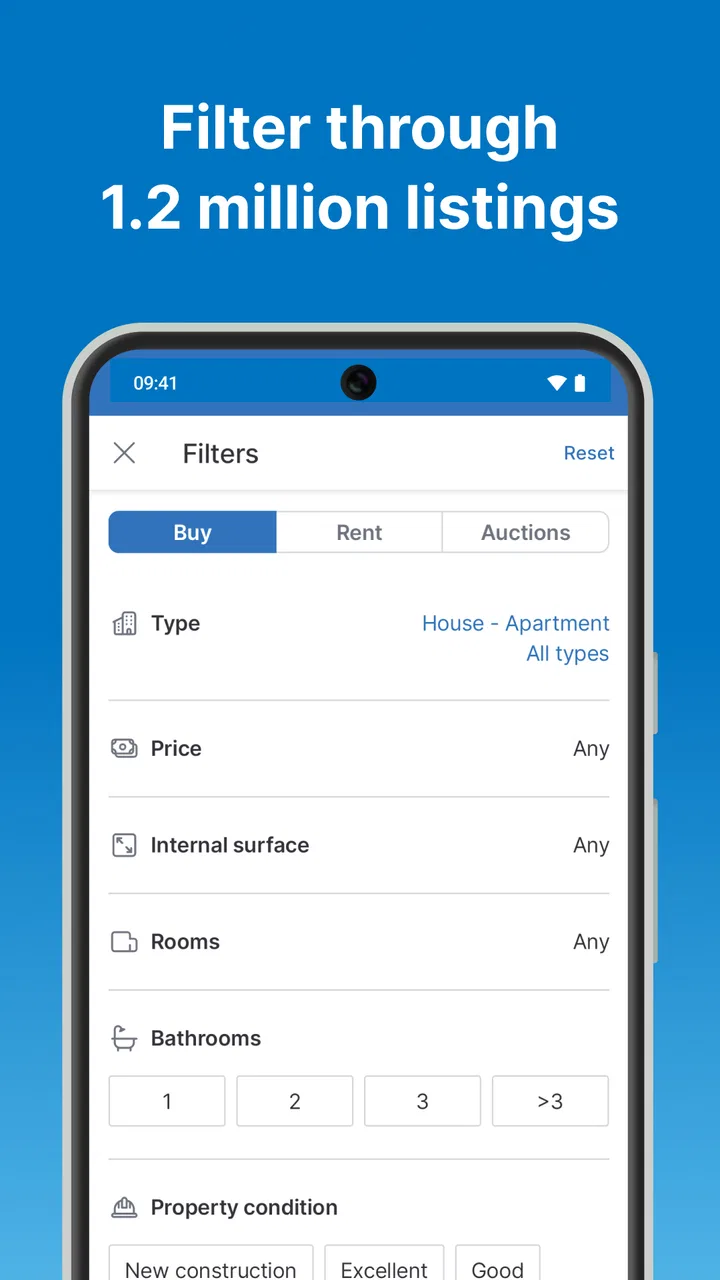
Once I have defined the search, I use the filters to reduce noise. The point is not to create a perfect search immediately. It is to remove listings that clearly cannot work, then inspect the remaining homes with more attention. A narrow search can hide useful alternatives, while a completely open search produces too many distractions, so I prefer starting moderately and tightening it after seeing the local market.
Location deserves special care. A city label can cover very different neighborhoods, and a home that looks close on a map may be inconvenient in daily life. I would check the surrounding area, estimate the route to work or school, and consider whether the property fits my routine at different times of day. The app helps me discover candidates, but it cannot replace a real visit or local knowledge.
When comparing Italy and Spain, I would also avoid assuming that similar words describe identical housing situations. A “room” or “apartment” can represent different expectations depending on the market and the listing. I would read the complete description, inspect every available image, and treat the headline as an invitation to investigate rather than as a final summary.
Read listings as evidence, not promises
A property card is useful for scanning, but the detailed listing is where the real work begins. I look for the information that affects the decision: the exact area, the type of property, the condition shown in photographs, the layout, and any wording that suggests restrictions or additional requirements. I also compare the description with the images. If the text emphasizes brightness but the photographs show only limited natural light, that difference becomes part of my evaluation.
One practical habit is to separate facts from impressions. “Two bedrooms” is a fact stated by the listing; “ideal for a family” is an interpretation. “Near the center” is less useful than checking the map and planning the route myself. This approach reduces the chance of becoming attached to a home because of polished wording before confirming whether it suits everyday life.
I also keep a small comparison note outside the app. For each serious candidate, I record the total expected monthly cost, location, size, condition, and the questions I need to ask. Property searches often become confusing because several homes begin to look alike. A short note prevents me from messaging the same concern repeatedly or forgetting why one listing was rejected.
Turn browsing into a shortlist
The app is strongest during the transition from broad discovery to a manageable shortlist. I would not contact every property that looks acceptable. Instead, I would choose a few that satisfy the non-negotiable requirements and a couple that represent sensible compromises. That gives me a useful spread: a safe match, a more ambitious option, and a fallback.
This is also where I would watch for stale enthusiasm. A beautiful photograph can make a listing feel urgent, but urgency is not a substitute for checking location, costs, availability, and the identity of the person or agency handling it. The app can put an opportunity in front of me; I still need to decide whether the opportunity is credible and suitable.
Prepare before making contact
Before sending a message, I prepare a short set of questions tailored to the listing. I might ask whether the property is still available, what the next step is, which costs are separate, and whether the details shown in the description are current. I would also state my situation clearly: intended move-in timing, length of stay if relevant, and whether I am looking for a rental or a purchase.
This preparation is a small but important workflow improvement. A vague message often produces a vague reply, while a concise message gives the other side something concrete to answer. It also helps me compare responses later. If one contact is clear and organized and another avoids basic questions, that difference is useful information about the process even before a viewing.
Understand the handoff to the advertiser
The most important handoff occurs when the search leaves the app and becomes a conversation with the advertiser. At that point, the app is no longer the whole experience. The listing may be managed by an agency, an owner, or another professional contact, and the quality of the next step depends on how accurately the listing is maintained and how quickly the contact responds.
I see this as a boundary rather than a flaw unique to this app. A property platform can organize discovery, but it cannot make every advertiser equally responsive or every listing equally current. My advice is to treat the first reply as the beginning of verification. Confirm the address area, availability, costs, viewing arrangements, and any conditions before spending time or money traveling.
For cross-border searches, this handoff deserves even more attention. If I am not yet in Italy or Spain, I would ask whether a remote viewing is possible and what documents or steps will be expected later. I would not assume that a promising listing can be finalized entirely through the app. The platform helps me find the conversation; the conversation determines whether the home is actually attainable.
Use the app alongside, not instead of, local checks
Compared with relying on word of mouth, printed notices, or searching the web one agency at a time, Immobiliare.it - Indomio gives me a more structured starting point. The advantage is breadth and consistency: I can search homes in the two supported countries through one property-focused app and build a shortlist without jumping between unrelated sources.
That does not mean it replaces local alternatives. A local agency may know about properties that are not visible in the same places, while personal contacts can provide context about a neighborhood that no listing captures. General web searches may also be useful when I want broader information about transport, schools, or local services. I would use this app for inventory and comparison, then use other sources for neighborhood research and independent checks.
The trade-off is convenience versus verification. A centralized search saves time at the beginning, but it can encourage me to believe that everything important is contained in the listing. It is not. The best workflow treats the app as the organized front door, not as the entire real-estate transaction.
What the popularity tells me—and what it does not
The app has an average rating of 4.8 from around 184 thousand ratings, and it has passed 10 million installs. That level of adoption makes me more comfortable recommending it as a serious starting point rather than an obscure experiment. It also suggests that many people find the basic search experience useful enough to keep using.
Still, popularity does not guarantee that every result will fit my needs. Housing inventory changes, advertisers differ, and a strong app cannot improve a neighborhood that is outside my budget. I would interpret the rating as evidence that the product is broadly useful, not as proof that it will solve a difficult search without effort.
Where the workflow becomes frustrating
The first point of friction is the gap between browsing and action. Scrolling through homes feels productive, but the result is only valuable if I can turn it into a verified shortlist and meaningful conversations. If I save too many possibilities without recording why they matter, the app becomes a stream of attractive images rather than a decision tool.
The second limitation is inherent to property information: listings can become less useful when details are incomplete, unclear, or no longer current. I would be cautious with homes whose photographs, description, and location do not seem to agree. I would also avoid making a financial decision from the app alone, especially when the move involves another country, unfamiliar procedures, or a significant commitment.
A third issue is that the app is not the right choice for every housing question. If I only need advice about tenancy law, neighborhood safety, mortgage planning, or moving logistics, a property search app is not enough. If I already have a trusted local agent handling the entire search, using another platform may add little value. Its best role is for people who need to discover and compare available homes before choosing which conversations deserve their time.
Practical habits that improve the outcome
I would begin with a wider geographic area than my final target, then narrow it after seeing realistic prices and property types. This is particularly helpful when moving to an unfamiliar city. The initial search teaches me whether my expectations are aligned with the market, while the second pass can focus on the neighborhoods that actually offer workable options.
I would also review the search at different moments instead of judging a city from one browsing session. New opportunities and changed availability can affect the shortlist, and a home that looked like the obvious choice may feel less attractive after comparing it with alternatives. The key is to revisit the criteria, not simply chase the newest photograph.
For every serious listing, I would create a three-part handoff note: what the listing claims, what I still need to verify, and what would make me reject it. This is more useful than saving a home without context. It also makes conversations shorter and helps me recognize when an answer does not address the original question.
Who should use it
I would recommend Immobiliare.it - Indomio to renters, buyers, students, families, and people planning a move who want a focused way to explore homes in Italy and Spain. It is especially practical for someone at the starting stage, when the main challenge is understanding what is available and turning a broad idea into a realistic shortlist.
It is also a good fit for a person comparing cities across borders. Using one app for both countries reduces the mental overhead of changing tools, and the shared workflow makes it easier to compare areas, budgets, and property styles. I would still add local research and direct verification, but the app gives the search a clear structure.
Who may be better served elsewhere
I would hesitate to recommend it as the only tool for someone with highly specialized requirements, a fixed professional intermediary, or a need for detailed legal and financial guidance. It is also not ideal for anyone who expects a search result to equal a confirmed home. The final decision still requires communication, checks, and often an in-person visit.
If I were searching in a country outside Italy or Spain, I would choose a platform focused on that market instead. The app’s country focus is a strength when it matches my destination and a limitation when it does not. Likewise, if my priority were neighborhood intelligence rather than property discovery, I would supplement it with maps, local communities, and official sources.
My final view after following the whole process
After using the app as a complete workflow—from defining the need to comparing listings and preparing contact—I see Immobiliare.it - Indomio as a practical discovery and organization tool. Its free access removes an obvious barrier, and its focus on Italy and Spain gives it a clear purpose. The strong average rating and broad install base support that impression, while the app’s long availability shows that it is an established option for this kind of search.
My recommendation comes with one condition: keep ownership of the decision. Use the filters to shape the search, read listings critically, record comparisons, and treat every advertiser handoff as a verification stage. Do that, and the app can save real time while helping you move from “I need a home somewhere” to a shortlist you can actually act on. Skip those checks, and even the most convenient property platform can leave you with attractive listings but no reliable outcome.
FAQs for Immobiliare.it - Indomio
01What features does Immobiliare.it - Indomio offer for property seekers?
Immobiliare.it - Indomio provides a comprehensive platform for property seekers, offering features such as detailed property listings, high-quality images, virtual tours, and interactive maps. Users can filter searches by price, location, and property type. The app also includes alerts for new listings and the ability to save favorite properties for easy access.
02Is Immobiliare.it - Indomio available in multiple languages?
Yes, Immobiliare.it - Indomio supports multiple languages to cater to a diverse user base. This feature ensures that users from different regions can navigate the app easily and understand property details without language barriers, enhancing the overall user experience and accessibility.
03How does Immobiliare.it - Indomio ensure the accuracy of its property listings?
Immobiliare.it - Indomio collaborates with verified real estate agencies and property owners to ensure the accuracy and reliability of its listings. The platform regularly updates its database and employs strict verification processes to maintain the integrity of property information, helping users make informed decisions.
04Can I use Immobiliare.it - Indomio to list my property for sale or rent?
Yes, Immobiliare.it - Indomio allows users to list properties for sale or rent. The app provides a user-friendly interface to upload property details, images, and contact information. This feature helps homeowners and real estate agents reach a wider audience and manage their listings efficiently.
05Is Immobiliare.it - Indomio free to use, or does it require a subscription?
Immobiliare.it - Indomio is free to download and use for browsing property listings. However, certain advanced features or services, such as premium listings or advertising, may require a subscription or one-time fees. Users should check the app for specific pricing details and available packages.
Pros
- User-friendly interface with intuitive navigation.
- Comprehensive property listings and filters.
- Advanced search options for precise results.
- High-quality images and virtual tours available.
- Regular updates with the latest market data.
Cons
- Limited international property listings.
- Occasional app crashes reported by users.
- Some features require account registration.
- Notifications can be overly frequent.
- Limited language support beyond Italian.

Immobiliare.it - Indomio
Gallery